
A loss adjuster is appointed and paid by your insurer to assess your claim. A loss assessor is someone you choose to hire, and pay, to prepare and negotiate your claim for you. The names sound alike, and after a flood both may turn up within days. Here is who each one works for, how they are paid, when an assessor is worth it, and the same questions for the builders and drying companies who follow.
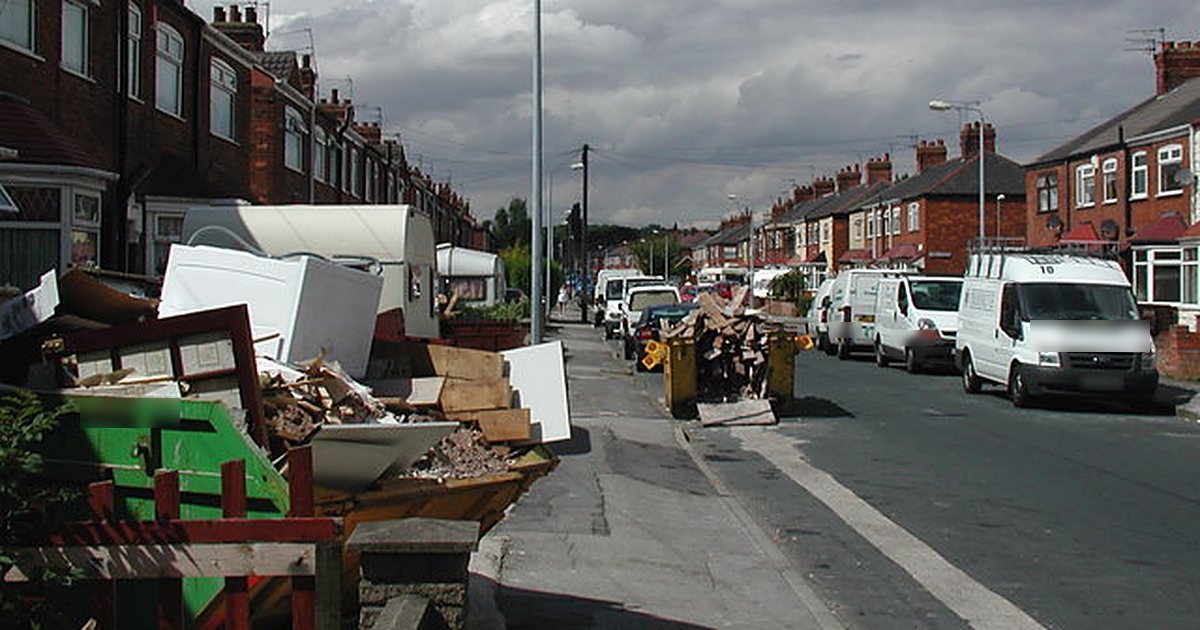
Trade vans, skips and caravans on Seaton Road, Hessle, during the clean-up after the floods of summer 2007. Photo: Paul Glazzard / Geograph, CC BY-SA 2.0, cropped, company names and number plates blurred (illustrative only; nothing shown is connected with this article)
Published 25 November 2026 · A RISE guide · 7–9 minute read
Our guide to the first 72 hours after a flood asks one question early: whose interests is each person in your house representing? This article answers it in full, for everyone a flooded homeowner is likely to meet. The facts come mainly from the insurance industry's own flood guide, published by the Association of British Insurers (ABI) in October 2025, and from the law that decides who must be regulated.
| Who | Who appoints them | Who pays them | What to check |
|---|---|---|---|
| Loss adjuster | Your insurer | Your insurer | Their name, firm and direct contact details, and the timetable for your claim |
| Loss assessor | You, if you choose to | You | That they are FCA-authorised, and every cost and charge in writing |
| Insurer's builder and drying company | Your insurer or its loss adjuster | Your insurer | The scope of works and the guarantee |
| Your own surveyor (surveyor-led repair) | You, with your insurer’s agreement | Your insurer, where your policy covers professional fees | Written agreement from your insurer that it will pay in stages against the surveyor’s sign-off |
| Your own builder (cash settlement) | You | You, from the settlement | Qualifications, references, a written contract and guarantee |
| Independent adviser | You | You | Exactly what they will and will not do for you |
The short version: if your insurer appointed them, they work for your insurer, even when they are kind, helpful and fair to you. If you appointed them, they work for you, and you pay.
The ABI's flood guide describes a loss adjuster as a specialist in assessing damage who is independent of the insurance company "but engaged and paid by it", who checks that a claim is covered and negotiates with the policyholder. After a flood, the adjuster usually does far more than assess. According to the guide, your loss adjuster:
The Chartered Institute of Loss Adjusters (CILA), the profession's own body, calls a loss adjuster "an impartial evaluator". Many adjusters are fair and do the job well. But impartial is not the same as being on your side. The fee is paid by the insurer, and the claim is settled within the policy as the insurer reads it. Expect fairness, check it, and keep your own record of every conversation.
In RISE’s founder’s own claim, the loss adjuster challenged payments at several stages. Each time, a formal complaint to the insurer settled it in the homeowner’s favour, with compensation for the trouble. If an adjuster’s decision looks wrong, ask for it in writing and use the insurer’s complaints process. It costs nothing.
A loss assessor works for you. The ABI's guide defines one as "a person who negotiates claims on behalf of policyholders" and says plainly that the fee "is paid for by the policyholder, not the insurer". It adds that a loss assessor's costs and charges are "not recoverable from your insurer".
Loss assessors usually charge in one of two ways:
Neither model is wrong in itself, but you should know which one you are signing up to, and what it means for who controls your repairs.
Yes, in practice. The ABI's guide states that "the Financial Conduct Authority regulates loss assessors, and you should only employ one that's been authorised by them." The law behind this is in the order that defines regulated financial activities. Assisting in the administration and performance of a contract of insurance is a regulated activity, and the exclusion covers loss adjusting and claims management done on behalf of an insurer. Someone helping you, the policyholder, with your claim does not fall within that exclusion.
Before you sign anything, look the firm up on the FCA register. A loss adjuster appointed by your insurer will not need to appear there in the same way, because they are acting for the insurer.
Often you do not, and if your claim is straightforward, a percentage fee can cost you more than it gains. MoneySavingExpert's advice is to make the claim yourself first and consider an assessor only if you are unhappy with the insurer's offer, and that an assessor is most useful on a large, costly claim. In our view, an assessor can be worth considering when:
Before you pay anyone a percentage, remember the free routes. You can complain to your insurer, and if that does not resolve it, take the complaint to the Financial Ombudsman Service, which says: "You don't need to pay to bring a complaint to us." Our guide to disputing a flood insurance decision sets out the steps. CILA also notes that some policies include a "Claims Preparation Clause" that covers the cost of an adjuster you appoint yourself, so check your policy wording.
This is the question most homeowners forget to ask. If your insurer or loss adjuster appoints the builder, the ABI's guide says your insurer "is responsible for the work of builders they appoint", and that insurers "will guarantee the work where it's carried out by their approved loss adjusters or contractors".
If you take a cash settlement and use your own builder, that guarantee goes. The guide is clear that you will "be responsible for the quality of the repair work undertaken by your chosen suppliers", and the insurer is not responsible if the work is faulty or has to be redone. A cash settlement gives you control, but the risk moves to you.
There is often a third route. Some policies let you appoint your own surveyor to oversee the rebuild. At each stage the surveyor checks the work, signs it off and issues a certificate with the invoice. You pass that to your loss adjuster, the insurer pays it, and the builder is paid, through the surveyor or by you directly. The work is still fully covered, but it is paid in stages as it progresses rather than in one lump sum. If something unexpected turns up once the floor is up or the walls are opened, it can be taken back to the insurer and dealt with case by case.
This route depends on your policy. It needs cover for professional fees that lets you appoint your own surveyor, and it gives you far more control than either alternative. In RISE’s founder’s experience, it was the route that got the job done properly, because the surveyor worked for the homeowner, not the insurer. Where the insurer runs the repair, the risk is a quick fix that makes the house look right again without the cause being properly investigated and put right. Where a neighbour took a lump sum, problems that only came to light once the house was stripped back left a large shortfall.
So when you buy or renew a policy, ask whether it covers professional fees and lets you appoint your own surveyor, and weigh the answer against how much risk you are willing to carry. Once you have flooded, it is too late to change what your policy allows.
A cash settlement is different. Once you accept it in full and final settlement, it is usually the end of the matter, and anything unforeseen is yours to pay for. The Financial Ombudsman Service has backed insurers on this. In one decision about a home damaged by an escape of water, where the homeowner later found the cash settlement was not enough, the ombudsman said it was not fair “to revisit that scope more than six months after a cash settlement”. In another, about a full and final buildings settlement, the ombudsman said it “would be unusual for this Service to interfere with that settlement”. Before you agree to anything, ask your insurer in writing which of these routes your policy allows.
Whichever route you take, see our guide to how long a flooded house takes to dry before anyone plasters, and ask your insurer whether it offers Build Back Better money for flood-resilient repairs.
Ask everyone who comes to your home after a flood the same five questions, and write down the answers with the date:
RISE is an independent adviser in the last row of the table above. We do not manage insurance claims, negotiate with insurers on your behalf or act as a loss assessor. We explain what your policy says and what your options are, and we provide independent evidence and reports you can share with your insurer. Our guide to what to do after a flood covers the first steps. If you want an independent view of where your claim and repairs stand, start with a case assessment or a free 30-minute call.
Sources: Association of British Insurers, Responding to Floods guide (October 2025); The Financial Services and Markets Act 2000 (Regulated Activities) Order 2001, article 39A and article 39B; The Consumer Contracts (Information, Cancellation and Additional Charges) Regulations 2013, regulation 30; Chartered Institute of Loss Adjusters, advice for policyholders; Financial Ombudsman Service, free, fair and final, and decisions DRN-5723962 and DRN-6195877; Gloucestershire County Council, cold callers after a flood; MoneySavingExpert, loss assessors (updated 12 May 2026). All checked 13 October 2026.
Live data from the Environment Agency, refreshed every 15 minutes.
No obligation. No jargon. By the end of the call you will have a clear view of your options — whether you engage RISE or not.
Call any time No callback RISE directly
Help us focus future content
RISE is researching gaps in publicly available flood recovery information. If you have 90 seconds, your responses help us understand what homeowners actually struggle to find clear answers on — and shape what we write next.
Take the 90-second survey →