
When your home floods, every professional who arrives is working for someone else. This is the plain-English guide to the first hours, the first weeks and the months that follow, written by people who have been flooded twice and know what the system does not tell you.
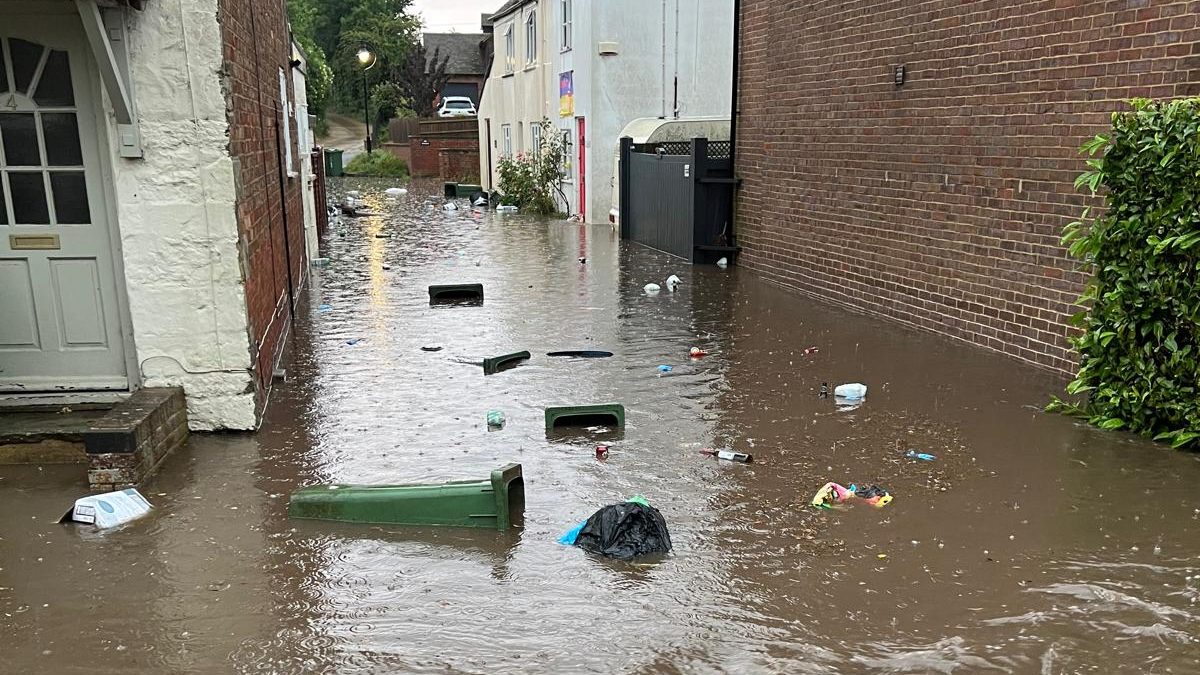
Buckinghamshire, 2023. No river, no floodplain, no flood warning. Surface water running through a village lane after heavy rain. Photo: RISE.
RISE Guide · Updated 30 September 2026 · 12 minute read
The first days after a flood decide most of what follows. The decisions are made fast, often by people in shock, and most of the professionals around you are paid by someone else. The loss adjuster works for the insurer. The contractor works for whoever signs their invoices. This guide is written for the person who lives in the house.
Work through it in order. Each part tells you what to do, what to ask, and what to write down. If your home has only just flooded, read our emergency page first, then come back here. For the first few days on their own, see The First 72 Hours. For the full reference on every stage, including Scotland, Wales and Northern Ireland, see The Complete Flood Recovery Guide.
Floodwater in the UK carries sewage, oil and chemicals. Treat everything it touched as contaminated until it has been cleaned.
Check warnings and alerts for your area on Where is it flooding right now?, which updates every 15 minutes from the Environment Agency.
If tap water looks discoloured or smells odd, do not use it. Call your water company. If you have a well or spring, treat it as unsafe until your local authority says otherwise. Boiling kills bacteria and viruses. It does not remove chemicals.
Your photographs and notes are the foundation of the insurance claim, and of any council flood investigation. They are also the evidence that stops anyone telling you it was only a little water.
Check with your insurer before throwing anything away. If it is a health risk, such as spoiled food or a soaked mattress, photograph it first, then dispose of it. Keep the photograph with your contents list.
Report the flood straight away, by phone and in writing. Get a claim number and the name of your handler. Then ask the questions that decide how the next year goes.
Do not accept a cash settlement for building repairs until you know what a proper, resilient repair costs. If your insurer disputes cover or the settlement looks short, talk to us before you reply. Been refused cover, or quoted a huge premium after a flood? See why flooded homes struggle to get cover.
Tell your landlord in writing straight away. The landlord’s insurance covers the building. Your own contents insurance covers your belongings. Ask in writing how rent and alternative accommodation will be handled while the home is uninhabitable.
Tell your council on day one, document everything exactly as above, and ask what local support is available. Ask the National Flood Forum (01299 403055) about grants and practical help.
Silt sets hard once it dries, so take it out while it is wet.
| Item | Usually | Why |
|---|---|---|
| Fitted carpet and underlay | Bin | Underlay soaks up contaminated water and cannot be decontaminated properly. |
| Loose rugs | Try to save | Often rescued if the water is extracted quickly and the rug is professionally cleaned. |
| Mattresses, cushions, stuffed furniture | Bin | The filling holds contamination. Photograph, then agree with your insurer. |
| Solid wood furniture | Clean | Clean it and let it dry slowly, away from direct heat, to limit warping and splitting. |
| Chipboard and MDF units | Expect to replace | They swell and break down when soaked. |
| Electrical appliances | Do not switch on | Dry fully and have them checked by a qualified person first. |
| Wooden chopping boards and spoons | Bin | Wood absorbs contamination and cannot be reliably disinfected. |
| Wet books, photographs, papers | Freeze | Freezing holds wet paper until you can deal with it and stops mould spreading. |
| Sandbags that touched floodwater | Council tip | Take them to a household waste recycling centre and tell staff. Never in household bins. |
Leave oil and petrol films on the water alone. Report persistent contamination to the Environment Agency on 0800 80 70 60. If you have a septic tank, avoid using it while it is flooded, flush sparingly, arrange a professional emptying, and report the damage.
Drying is the most important part of the repair, and the part most likely to be rushed. A seriously flooded house can take many weeks, sometimes months, to dry. Start straight away with ventilation, dehumidifiers and steady, moderate heat. Then measure. How a wall looks or feels tells you nothing reliable.
Closing up too soon. Painting over damp plaster, laying flooring on damp screed or putting kitchen units back against wet walls traps moisture, feeds mould and forces you to strip it out again. Ask for the drying records to be part of the signed repair scope.
That is why RISE insists on inspection and recorded drying before anything is closed up. The second rebuild followed BS 85500:2025 and CIRIA C790, and the detail is on The Evidence page.
You cannot stop every flood. You can decide how much damage the next one does and how quickly you are back home. RISE calls this the Three-R Method.
Door and airbrick guards, non-return valves on drains, sealed service penetrations, and the council infrastructure that should be protecting your street.
Resilient materials and rebuild decisions, including Build Back Better entitlements. Raised electrics, solid floors, water-resistant plaster and kitchens.
Your claim paid in full, your rebuild done properly, and your council held to its Section 19 duty.
Flood Re estimates 6.3 million properties in England are at risk of flooding and that wider property flood resilience could cut annual losses by around £740 million. It is also developing Flood Performance Certificates, which will rate a home’s flood resilience in a similar way to an EPC, with pilots planned to start by the end of 2026 and discounts targeted for 2028. Read more on the Flood Performance Certificates blog.
Most flood victims are told it was the weather. Often it was a collapsed culvert, a gully nobody cleared, an obstructed watercourse or a drain built for half today’s rainfall. Under Section 19 of the Flood and Water Management Act 2010, when your lead local flood authority becomes aware of a flood in its area, it must investigate to the extent it considers necessary or appropriate. The investigation identifies which bodies, such as the council, water company or Environment Agency, have responsibility and whether they have acted. The authority then publishes its findings.
A Section 19 investigation in Buckinghamshire, backed by sustained pressure from residents and a councillor, led to over £2 million of council-funded drainage works. The introduction is in our Section 19 guide, the full statutory detail is in the Section 19 Reference Manual, and the Section 19 Case Assessment (£250) reviews your own evidence and sets out the strongest case to put to your council.
Local government boundaries are being reorganised in parts of England. Use Find Your Flood Contacts to look up your lead local flood authority by postcode, or GOV.UK Find your local council.
Local guides with every published Section 19 report: Buckinghamshire, Oxfordshire, Northamptonshire and Bedfordshire.
| Source | What it can help with |
|---|---|
| Your insurer | Emergency repairs, drying, alternative accommodation, contents, and Build Back Better where your policy includes it. |
| Flood Re | Helps insurers cover higher-risk homes and funds Build Back Better. Homes built from 1 January 2009 onwards sit outside it. The scheme is planned to run until 2039. See how Flood Re works and who it leaves out. |
| Your council | Advice, clean-up support, asbestos identification, and any local grants. Ask whether a government recovery grant has been activated for your flood. |
| National Flood Forum | 01299 403055. Practical and emotional support from people who have been flooded. |
| Citizens Advice | Help with housing, money and disputes after a flood. |
| NHS 111 and your GP | Health concerns and mental health support, including NHS Talking Therapies. |
Tick items off as you go. Your ticks are saved in this browser only.
It depends on how deep the water was, how long it stayed, how the walls and floors are built and whether there is insulation in the cavities or under the floor. Many homes need weeks. Seriously flooded, solid-walled or heavily insulated homes can need months. Go by recorded moisture readings against a dry reference, not by a calendar or by how a wall feels.
Check your policy wording and ask in writing before anyone starts work. Many homeowners are told they have no choice when the wording is less clear than that. Whoever does the work, agree the drying method, the moisture readings and the sign-off in writing first.
Possibly. Under Flood Re's Build Back Better scheme, eligible policies can pay up to £10,000 on top of the claim for flood resilience measures when your home is repaired. It is voluntary for insurers, so ask yours in writing, and ask before the repair scope is agreed.
Yes. Floodwater in the UK commonly carries sewage, oil and other contaminants. Treat every surface it touched as contaminated until it has been cleaned and disinfected.
No. Steady, moderate heat with good ventilation and dehumidifiers works best. Very hot, fast heating can crack plaster and warp timber without drying the core of the wall.
Under Section 19 of the Flood and Water Management Act 2010, when your lead local flood authority becomes aware of a flood in its area, it must investigate to the extent it considers necessary or appropriate. It decides what meets its own threshold, so send evidence early and ask for the decision in writing.
For septic tank damage or pollution, call the Environment Agency incident hotline on 0800 80 70 60. For a private supply, assume it is unsafe and contact your local authority before using it.
Tell your landlord in writing straight away. The landlord's insurance covers the building and your own contents insurance covers your belongings. Ask in writing how rent and alternative accommodation will be handled while the home is uninhabitable.
This guide is general information for homeowners in England. It is not insurance, legal, health or engineering advice. Follow instructions from the emergency services, your insurer and qualified professionals for your own property.
Live data from the Environment Agency, refreshed every 15 minutes.
No obligation. No jargon. By the end of the call you will have a clear view of your options — whether you engage RISE or not.
Call any time No callback RISE directly
Help us focus future content
RISE is researching gaps in publicly available flood recovery information. If you have 90 seconds, your responses help us understand what homeowners actually struggle to find clear answers on — and shape what we write next.
Take the 90-second survey →