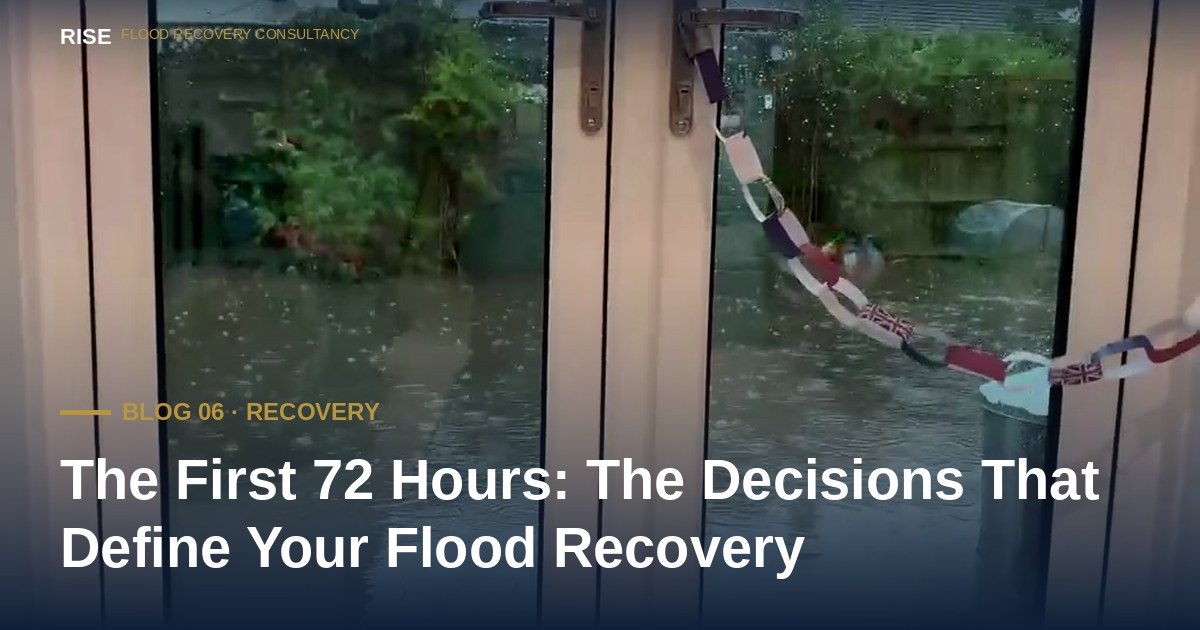
When a home floods, three parties arrive in quick succession: the insurer, the loss adjuster, and the contractor. None of them work for you. The decisions made in the first 72 hours determine almost everything that follows.
Published June 2026 · RISE Flood Recovery Consultancy
When a home floods, the decisions made in the first 72 hours determine almost everything that follows. The quality of the drying process. The scope of the insurance claim. Whether the family moves back in six months or eighteen. Whether the rebuild is done correctly or has to be redone. Whether the underlying drainage problem is ever addressed.
Most flood victims make at least two costly mistakes before any independent help arrives. Not because they are careless — but because they are dealing with a crisis they have never faced before, under enormous stress, relying on advice from people whose interests are not aligned with theirs.
This article sets out what those mistakes are, what to do instead, and why the first 72 hours matter more than any other period in the recovery process.
When a home floods, three parties typically arrive in quick succession: the insurer, the loss adjuster, and the insurer's preferred contractor. It is important to understand who each of them works for.
The loss adjuster works for the insurer. Their role is to assess the claim and manage its cost. They are professionals and most operate with integrity — but their client is not you.
The insurer's preferred contractor works for whoever signs their invoices. They want to complete the work efficiently and maintain their relationship with the insurer who provides them with a steady flow of contracts. They are not your representative.
The insurer is managing financial risk across a portfolio of claims. Your individual claim is one line in a spreadsheet. Their interest is in closing it as efficiently as possible.
Nobody in that room is working for you. RISE was founded because that gap needed to be filled.
Speed feels like progress. When water is in your home and your family is displaced, you want it fixed as fast as possible. This urgency is understandable — and it is exploited.
Drying and strip-out work started before the scope is properly agreed and documented creates a situation where changes become very difficult to make. If the specification later turns out to be inadequate — missing a damp-proof membrane requirement, skipping tanking, failing to follow BS 85500:2025 (the updated British Standard for flood-resilient construction, published in March 2025) — you have limited leverage once work is underway.
Take time to understand and agree the scope before any contractor starts work. A few days of delay at this stage is far less costly than a rebuild that has to be redone.
Every crack, every watermark, every item of damaged property — photograph it before anything is moved or touched. The loss adjuster will prepare their own assessment, but your independent record is irreplaceable. If a dispute arises later about what was damaged, or how high the water reached, or what the condition of the walls was before strip-out began, your photographs are your evidence.
Document the flood level on every wall. Document every affected room. Document your belongings. Do this before you do anything else.
Most home insurance policies include an accommodation limit — a maximum payment for alternative living costs while your home is uninhabitable. Many homeowners accept the first accommodation option offered without understanding that the limit may need to cover not just rent but council tax, storage, additional travel costs, school transport, and other displacement costs.
Understand your policy's accommodation provisions before you agree to anything. The insurer is not obliged to volunteer the full scope of what you are entitled to claim.
If your insurer offers Flood Re's Build Back Better scheme, it can pay up to £10,000 towards flood resilience improvements as part of your reinstatement claim. This can fund flood doors, raised electrical sockets, water-resistant flooring, non-return valves, and other measures that materially reduce the impact of any future flooding.
The scheme has been available since 2022. More than 70% of the residential insurance market now offers it. But according to Flood Re's own 2025 annual reporting, Flood Re says only about a third of eligible claims use it — and many flood victims never have it offered to them at all. The insurer is not required to tell you about Build Back Better proactively. You have to ask.
The average domestic flood claim reached £30,000 in 2025, according to the Association of British Insurers, and serious whole-house floods cost far more, with some claims exceeding £100,000. Flood Re itself, the government-backed reinsurance scheme that underpins flood cover in the UK, paid £159.6 million in claims in the year to 31 March 2025, down from £211.2 million the year before, while the number of policies it covers hit a record, up 20% in a single year.
*Updated 17 September 2026, 11:56 BST — The £159.6 million figure above was Flood Re's record for the year ending 31 March 2025. Its FY2025/26 annual report, published in July 2026, confirms claims came in lower than expected for the most recent year, so this is no longer the current record, though it remains an accurate historical high.
These are not abstract numbers. They are the financial scale of what is in play during the first 72 hours after your home floods. Decisions made under stress, in the first three days, will determine which side of these distributions your claim ends up on.
RISE Flood Recovery Consultancy can be engaged from the first day of a flood event. We attend the property, review the insurer's proposed scope, challenge inadequate specifications, advocate for your accommodation entitlement, ensure Build Back Better is claimed, and project-manage the rebuild on your behalf from initial strip-out to final snagging.
We have personally been through this process — twice. We know what the system looks like from the homeowner's side. We know where it fails. And we know how to push back through it.
If your home has flooded — or you are concerned it might — contact us. The consultation is free. The advice is independent. And we work exclusively for you.
This article is the sixth in RISE's six-part series on flood risk and recovery in Buckinghamshire, Oxfordshire, Northamptonshire and Bedfordshire. Earlier articles cover the UK's emerging flood season and county-by-county risk profiles. For the deeper structural case on why surface water flooding receives so little public investment, see RISE's long-read The Cinderella of Flooding. The full series is available on the RISE blog.
Sources and further reading: BSI Knowledge, BS 85500:2025 Flood resilient construction (published 27 March 2025); Flood Re Annual Report and Accounts 2025; Insurance Business UK, coverage of Flood Re 2024/25 reporting (July 2025); Flood Re, Build Back Better guidance and uptake figures; Reinsurance News, Policies ceded to Flood Re hit record high in 2024/25.
No obligation. No jargon. By the end of the call you will have a clear view of your options — whether you engage RISE or not.
Call any time No callback RISE directly
Live data from the Environment Agency, refreshed every 15 minutes.
Help us focus future content
RISE is researching gaps in publicly available flood recovery information. If you have 90 seconds, your responses help us understand what homeowners actually struggle to find clear answers on — and shape what we write next.
Take the 90-second survey →