The most common flood risk in England is the one that never leads the news. A long read on what the regulator's own peer body found, what has changed since, and what it means for the homeowner who has just flooded.
Published June 2026 · A RISE long read · 10–12 minute read
On 25 November 2024, the emergency services declared a major incident in Northamptonshire. The River Nene was in full flood. A severe flood warning — the formal Environment Agency classification used to indicate danger to life — was issued at Billing Aquadrome, near Northampton. Schools across the county closed. Northampton Railway Station shut. A holiday park near the city was evacuated for the second time in a matter of weeks.
It did not lead the national news.
That is not unusual. In any given week, somewhere in England, communities are flooded. Properties are inundated. Families are displaced. The events are catalogued by the Environment Agency, sometimes investigated by Lead Local Flood Authorities, reported in the local newspapers. Then the news cycle moves on, and the next storm finds a different group of homes.
This article is about why that happens. It is also about what it costs the people who live through it.
The most common flood risk in England is not the one that makes the headlines.
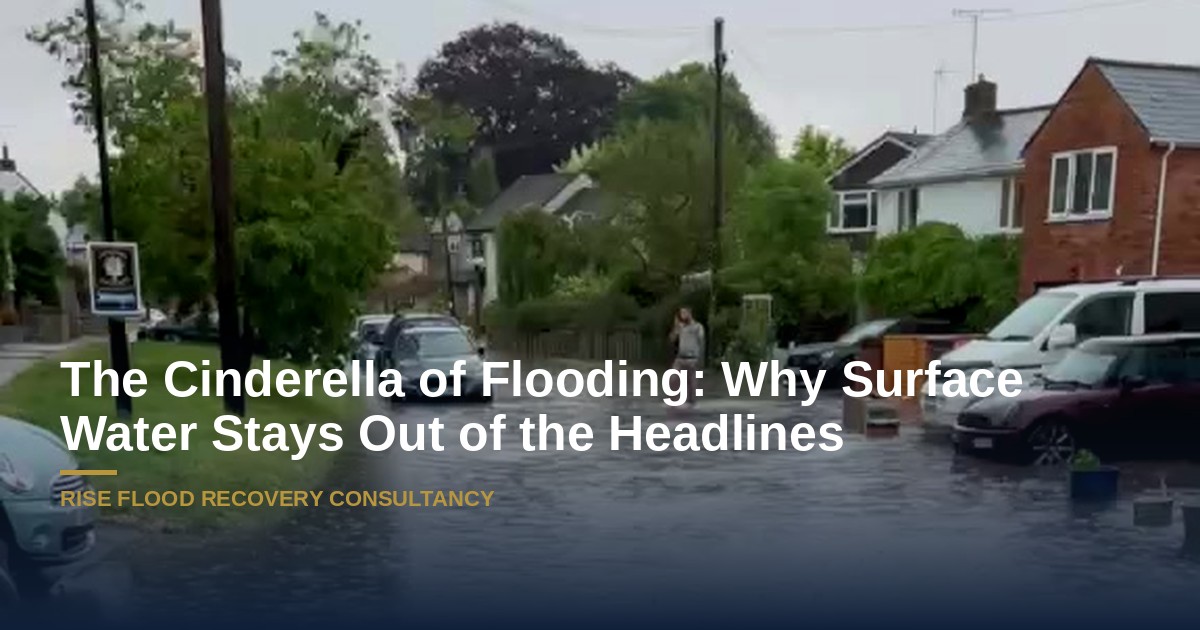
Severe river flooding gets the news cameras. The image of houses with brown water rising past the front door, of canoes paddling down the high street, is what flooding looks like in the national imagination. But for every property at significant risk from a river overtopping its banks, there are roughly three at risk from surface water flooding — the kind caused not by a river but by rain falling faster than the drainage beneath the streets can move it away.
The Environment Agency's most recent national assessment, updated in January 2025, puts approximately 4.6 million properties in England at risk from surface water flooding. The corresponding figure for river and sea flooding is around 1.6 million. Surface water flooding now affects roughly three times as many homes as river and coastal flooding combined — and yet it occupies a small fraction of the public conversation, and an even smaller fraction of public investment.
In May 2023, the Chartered Institution of Water and Environmental Management (CIWEM) — the professional body for the UK's water and environmental engineering sector — published a 109-page review of how surface water flooding is managed in England. The report was commissioned by the Association of SuDS Authorities and the Local Government Flood and Coastal Erosion Risk Management Technical Advisors Group. It drew on a survey of 89 Risk Management Authorities (RMAs) — local councils, water companies, the Environment Agency — and on focus groups with the people doing the work.
The report described surface water as the "Cinderella" of flooding sources.
It is worth pausing on that framing. The professional body that represents the sector responsible for managing surface water flooding chose, in a formal public report, to describe its own field as the one that nobody comes to the ball.
What the CIWEM report documented was not so much a system in trouble as a system that had not been built robustly enough to be in trouble in any coherent sense. Some of the headline findings:
Staffing. Around 54% of the Risk Management Authorities surveyed reported that they did not have a full complement of staff to deliver their surface water responsibilities. In unitary authorities — councils like Buckinghamshire, Central Bedfordshire and Oxfordshire — that figure rose to 68%. Around three quarters of respondents (74%) found it either challenging or very challenging to fill the posts they did have. Many cited uncompetitive pay, high workloads, and concerns about staff burnout.
Funding. Just over half of RMAs (52%) had any ring-fenced budget for surface water management at all. Of those, only around two in five had multi-year certainty — meaning that only about 21% of all the authorities surveyed were able to plan the kind of multi-year drainage interventions that materially reduce flood risk. The other 79% were either funding their work year-by-year or finding ad-hoc money where they could.
Coordination. Less than half (48%) of respondents felt the responsibilities of other Risk Management Authorities were clear to them — meaning that even within the system, the people running it were unsure who was supposed to do what. Only 31% considered the Environment Agency very clear in its role on surface water. Nearly two-thirds of respondents thought there should be a single authority co-ordinating surface water management, and that the Lead Local Flood Authority — the upper-tier council in a given area — was the obvious candidate. There is currently no such single-authority requirement in English law.
But the finding most directly relevant to the homeowner who has just flooded was not in any of those headline categories. It was buried in the report's section on Section 19 investigations — the formal, statutory mechanism by which Lead Local Flood Authorities are required to investigate floods, to the extent they consider necessary or appropriate, under the Flood and Water Management Act 2010. (See the Section 19 Reference Manual for the full statutory framework.)
When a Section 19 investigation involves more than one Risk Management Authority — and most of them do, because the drainage system itself crosses organisational boundaries — respondents reported that such investigations were significantly harder to progress to actual infrastructure change. Multiple authorities meant multiple budgets, multiple legal teams, multiple political timetables. The investigation might be completed. The remediation rarely followed at the same pace.
The CIWEM report drew heavily on a 2022 study from the National Infrastructure Commission, an independent body that advises Parliament on long-term infrastructure priorities. The NIC's report on surface water flooding made a single projection that has remained one of the most quoted figures in the sector ever since: without significant intervention, by 2055, up to 295,000 further properties in England could be at high risk from surface water flooding.
To translate that into more concrete language: roughly the homes of two cities the size of Leicester being added to the high-risk list over the next thirty years.
The CIWEM report's recommendations, taken together, were not exotic. Funding needed to be increased and protected from the year-to-year volatility that prevents long-term planning. Coordination between Risk Management Authorities needed to be clarified, ideally with a single lead authority. And sustainable drainage systems — the kind of nature-based and engineered drainage infrastructure that reduces runoff at source — needed to be made mandatory in new development, under Schedule 3 of the Flood and Water Management Act 2010, a provision Parliament had enacted in 2010 but never brought into force.
The 2023 report welcomed the government's January 2023 announcement that Schedule 3 would, finally, be implemented.
It has not been.
Schedule 3 of the Flood and Water Management Act remains, in 2026, exactly where it was in 2010: on the statute book, but never commenced. Implementation was first postponed in 2014. It was expected again in April 2025. That date passed.
In June 2025, the government introduced a new set of national planning standards for sustainable drainage, signalling that the route to better drainage in new developments would run through planning policy rather than through enforcing the act of Parliament that already exists.
A House of Commons Library briefing published in February 2026 made the government's current position explicit: better delivery of sustainable drainage may be achieved, ministers have said, through improving planning policy, adoption and maintenance, rather than through bringing Schedule 3 into force in England.
The postponement, as of 2026, is now twelve years long. The mechanism Parliament voted into existence to require sustainable drainage in new development has been on hold for the entire period during which the climate has been making surface water flooding measurably worse.
And the climate did not pause. November 2024 brought Storm Bert — the storm that triggered the major incident in Northamptonshire described at the start of this article, and that caused the Eynsham flooding in Oxfordshire later investigated under Section 19 in January 2026. September 2024 was confirmed by the Met Office as the wettest calendar month ever recorded in both Oxfordshire and Bedfordshire in series stretching back to 1836; in Oxfordshire specifically, the figure was 374% of the September average. The 2024/25 storm season brought Storms Bert, Darragh, Éowyn and Claudia in quick succession. The 2025/26 winter brought sustained flood alerts across Bedfordshire, Oxfordshire and Buckinghamshire from mid-January through February 2026.
The system identified as undersized and undercoordinated in May 2023 has been asked, in the years since, to do more work than ever — with the same staff, the same budgets, the same coordination problems, and without the legislative mechanism that was supposed to take the pressure off new development.
There is one finding in the CIWEM report that does not appear in the executive summary but recurs throughout the text. When the report tried to identify what made the difference between Risk Management Authorities that managed surface water reasonably well and those that did not, the answer was not consistent funding, or clear policy guidance, or strong national coordination.
The answer was individuals.
The report observed, repeatedly, that where the structural challenges of surface water management had been overcome, it was primarily down to individuals within the relevant authorities — people who built informal relationships across organisational boundaries, who found creative ways to align funding from different sources, who refused to accept the friction of the system as a reason to stop pushing.
The implication, if you read it carefully, is unsettling. A system built around statutory responsibility, codified roles and democratic accountability is, in practice, working only at the points where particular individuals personally refuse to let it not work.
What that observation has in common with the experience of a homeowner after flooding is more than coincidence. The same dynamic applies on the other side of the boundary.
The homeowners whose Section 19 investigations translate into actual infrastructure improvement, whose insurers actually deliver an adequate rebuild, whose displacement actually ends in a reasonable timeframe — they are, almost without exception, the ones whose advocates refused to let the structural friction of the system become an excuse for inaction. Sometimes that advocate is the homeowner themselves. Sometimes it is a family member with relevant professional experience. Sometimes it is a paid independent representative. The system that surrounds a flood claim is not designed to produce a fair outcome by default. It is designed to produce an efficient outcome from the insurer's, the contractor's, and the council's perspectives — which are not the same thing.
Most homeowners flood once in their lives, if they flood at all. They have neither the experience nor the time to become the kind of individual advocate that the CIWEM report described. They are facing a process built around assumptions that have nothing to do with their interests, surrounded by professionals whose contractual obligations are to other parties.
Stripped of the policy abstractions, what this all amounts to is this.
Surface water flooding is the most common flood risk in England. It will get worse. The system designed to manage it is, by the regulator's own peer body's published assessment, undersized, underfunded and inconsistently coordinated. The legislative mechanism designed to address it through new development standards has been postponed for twelve years. The recommendations made in May 2023 by CIWEM have, three years later, not been implemented. The government is not committed to implementing them in the form they were proposed.
If your home floods, what stands between your family and a multi-year recovery is not the system. The system has been politely, comprehensively documented as insufficient by its own professional body. What stands between your family and a multi-year recovery is the quality of the advocacy you have in your corner during the months that follow.
You can do that work yourself. Many homeowners do — and over months and years, learn what RISE has already learnt. Others choose not to. There is no right answer to that question. There is only the question of which costs you are willing to pay: the cost of the time, or the cost of doing it alone, or the cost of getting help.
The point of this article is not to argue for any one of those answers. The point is to make clear what the choice actually is.
Sources and further reading: CIWEM, Surface Water Management: A Review of the Opportunities and Challenges (May 2023, full report); National Infrastructure Commission, Reducing the Risk of Surface Water Flooding (November 2022); House of Commons Library, briefing on Schedule 3 of the Flood and Water Management Act 2010 (February 2026); Met Office, Record-breaking rainfall for some this September (October 2024); BBC News, live coverage of Storm Bert in Northamptonshire (25 November 2024); Environment Agency, National Assessment of Flood and Coastal Erosion Risk in England 2024 (NaFRA2, published January 2025); Defra, National Standards for Sustainable Drainage Systems (June 2025).
Live data from the Environment Agency, refreshed every 15 minutes.
No obligation. No jargon. By the end of the call you will have a clear view of your options — whether you engage RISE or not.
Call any time No callback RISE directly
Help us focus future content
RISE is researching gaps in publicly available flood recovery information. If you have 90 seconds, your responses help us understand what homeowners actually struggle to find clear answers on — and shape what we write next.
Take the 90-second survey →