
Most homes built before 2009, lived in by the policyholder or their family and in council tax bands A to H can have their flood cover backed by Flood Re. You cannot buy it yourself and it is not named on your policy: your insurer decides whether to use it. Here are the eight tests, what Flood Re charges for each council tax band, and how to ask.
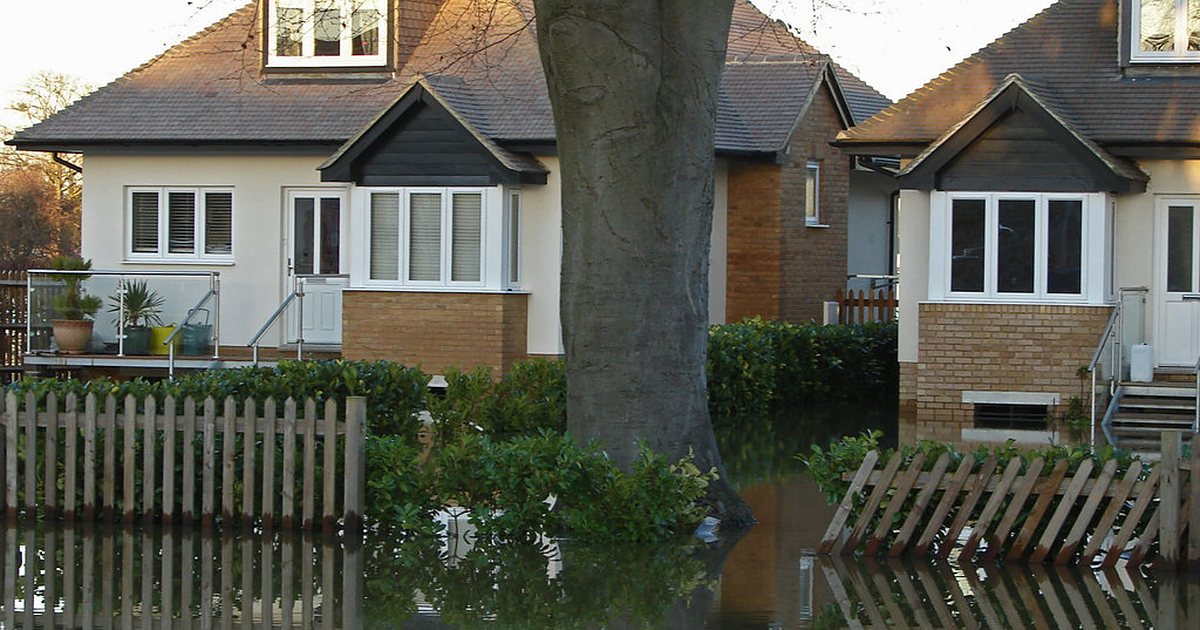
Thames riverside homes at Chertsey, Surrey, in the January 2014 floods. Photo: Alan Hunt / Geograph, CC BY-SA 2.0, cropped (illustrative only; nothing shown is connected with this article)
Published 19 November 2026 · A RISE guide · 7–9 minute read
Flood Re backed an estimated 353,000 home insurance policies in the year to March 2026, and has helped more than 742,000 households since it began in 2016. Many of those households will never have heard of it, because it works behind the scenes. Our guide to refused flood insurance and high premiums covers what to do when cover is hard to find. This one goes through Flood Re eligibility in detail, so you can tell whether your home qualifies before you start shopping.
Every insurer that sells home insurance in the UK pays a levy into the scheme, which raises £160 million a year. When you buy home insurance, your insurer can choose to pass the flood part of your policy to Flood Re for a fixed price set by your home's council tax band. If you make a valid flood claim, your insurer pays it and Flood Re reimburses the insurer later.
Nothing changes for you. You buy and claim in the usual way. Flood Re does not sell to the public, and it says plainly that prices, excesses and terms are set by your insurer, not by Flood Re.
Flood Re's own criteria say a home qualifies only if it meets all of these:
Flood Re lists the kinds of property it expects to qualify for buildings or combined cover, as long as the eight tests above are also met:
It does not expect these to qualify for buildings cover: blocks of more than three flats, company-owned homes, housing association and social housing (contents cover can still qualify), bed and breakfasts paying business rates, farm outbuildings, portfolios of let properties, and commercial or multi-use buildings.
Contents cover reaches further than buildings cover. Flood Re will back a tenant's or leaseholder's contents policy even where the building itself would not qualify, such as a flat in a large block, as long as the policy and the home meet the eight tests.
You will not see Flood Re on your schedule, and Flood Re does not deal with householders. Meeting the eight tests does not guarantee it either: it is the insurer that chooses whether to pass your flood risk to the scheme. So the only way to know is to ask. A clear question to put to your insurer or broker is:
Flood Re also has a free online checker that asks five questions about your home and needs no personal details. It gives a general guide only, but it is a quick way to rule your home in or out before you ring round.
Flood Re publishes a list of about 60 participating insurers and brands, including Admiral, Ageas, Allianz, Aviva, AXA, Direct Line, Hastings, Hiscox, NFU Mutual, bank and building society brands such as Halifax, Lloyds Bank, Nationwide and Santander, Policy Expert, Tesco and Zurich. Two warnings come with it from Flood Re itself: insurers can choose not to be listed, and being on the list does not mean an insurer will offer you a policy or use the scheme for it. Flood Re's own advice is to shop around.
These are the amounts Flood Re charges your insurer, in pounds, for taking the flood risk on a home in England. They are not the price you pay: your insurer sets your premium and adds its own costs. Flood Re also applies a fixed £250 excess to each flood claim it reimburses.
| Council tax band | A | B | C | D | E | F | G | H |
|---|---|---|---|---|---|---|---|---|
| Buildings, from 1 April 2026 | 147 | 147 | 175 | 198 | 235 | 346 | 447 | 1,077 |
| Contents, from 1 April 2026 | 58 | 58 | 77 | 86 | 117 | 195 | 273 | 536 |
| Combined, from 1 April 2026 | 205 | 205 | 252 | 284 | 352 | 541 | 720 | 1,613 |
| Buildings, from 1 April 2027 | 152 | 152 | 181 | 218 | 272 | 357 | 462 | 1,113 |
| Contents, from 1 April 2027 | 25 | 25 | 80 | 95 | 140 | 201 | 282 | 554 |
| Combined, from 1 April 2027 | 177 | 177 | 261 | 313 | 412 | 558 | 744 | 1,667 |
The one big fall is for contents-only cover in bands A and B, from £58 to £25 from April 2027, which Flood Re says is aimed at lower-income households and renters and expects insurers to pass on. Almost every other figure rises. Flood Re also says that, with costs rising in three of the last four years, it has spent more repairing homes in bands G and H, under 4% of UK homes, than homes in bands A and B, around 45% of homes. Government has said it will work with Flood Re and insurers on reforming the premium structure, so expect more change.
Flood Re is due to run until 2039. After that, Flood Re says there will be a free market for flood insurance, with prices based on each home's actual risk. That is why its July 2026 reforms lean towards resilience: a pilot of Flood Performance Certificates, premium discounts for homes that have one or complete a self-assessment, and a stronger push for Build Back Better, which can add up to £10,000 of resilience measures to a flood repair. A home that can show it floods less, and recovers faster, is the home most likely to stay insurable after 2039.
If your home has flooded and you want an independent view of your cover, your repairs and whether Flood Re could apply, our Flood Recovery Guidance service includes a full review of your current policy. Start with a free 30-minute call.
Sources: Flood Re, eligibility criteria; how Flood Re works; find an insurer and eligibility checker; how premiums are set (2026/27 and 2027/28 tables); mixed-use homes; about Flood Re; ten-year reform package (1 July 2026); annual results for the year to 31 March 2026 (22 July 2026). All checked 12 October 2026.
Live data from the Environment Agency, refreshed every 15 minutes.
No obligation. No jargon. By the end of the call you will have a clear view of your options — whether you engage RISE or not.
Call any time No callback RISE directly
Help us focus future content
RISE is researching gaps in publicly available flood recovery information. If you have 90 seconds, your responses help us understand what homeowners actually struggle to find clear answers on — and shape what we write next.
Take the 90-second survey →