The head of Britain's biggest insurer says England is “for sure” building homes that could become uninsurable because of flood risk. Homes built from 2009 onwards sit outside Flood Re, the scheme that keeps flood cover affordable for older homes. Here is what Aviva's warning means if you own, or are about to buy, a new-build.
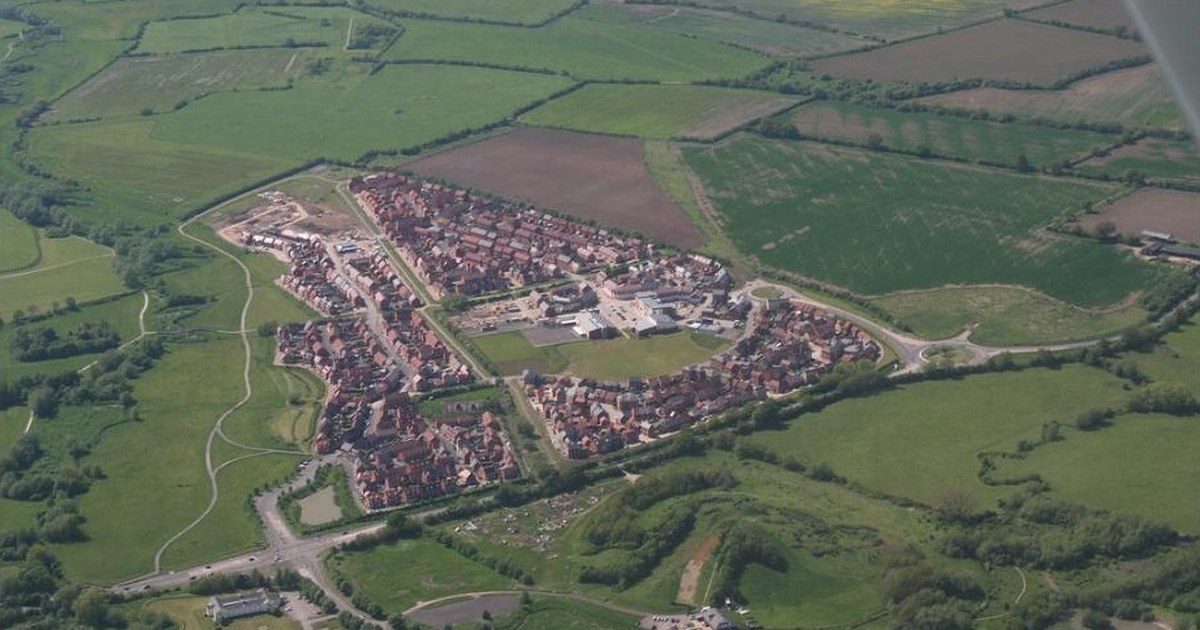
New housing estate at Weedon Hill, Aylesbury, Buckinghamshire (aerial, 2013). Photo: Chris / Geograph, CC BY-SA 2.0 (illustrative)
Published 30 September 2026 · News & analysis · 6–8 minute read · Updated 1 October 2026
The chief executive of Aviva, Dame Amanda Blanc, has said England is “for sure” building homes that could become uninsurable because of flood risk. She made the comments on the BBC's Big Boss Interview podcast, reported by BBC News and the Guardian on 29 September 2026.
When the head of the UK's largest insurer says this publicly, homeowners should pay attention. Insurance is what makes a home mortgageable and sellable. Lose it, and the whole financial picture changes.
One in nine new homes built in England between 2022 and 2024 sits in an area of medium or high flood risk, according to Aviva's February 2026 analysis. The trend is rising, not falling. We have not seen a newer Aviva study; Blanc's September warning builds on these figures.
| Measure | Figure |
|---|---|
| New homes 2022–2024 analysed | 396,602 |
| In medium or high flood-risk areas now | 43,937 (11%) |
| With some level of flood risk now | 101,657 (26%) |
| Share in flood-risk zones, 2013–2022 | 8% |
| 2022–2024 homes at medium or high risk by 2050 | 1 in 7 |
| New homes built 2022–2024 at some flood risk by 2050 | Almost 1 in 3 (30%), vs 1 in 4 existing homes |
| New homes built in highest-risk flood zones, past 10 years | 110,000 |
| Would be built in highest-risk zones over the next 10 years if the trend continued | 115,000 |
| Homes and businesses at flood risk in England (Environment Agency) | 6.3 million |
| Properties at flood risk by mid-century (Environment Agency) | About 8 million (1 in 4) |
Blanc also flagged surface water: “You've seen a very dry summer, and what happens if you then get heavy rain on very dry surfaces is you get more surface water flooding.” That is exactly the kind of flooding that catches people outside traditional river flood zones. The Met Office estimates that very wet winters like 2023–24 have gone from once-in-80-year events to once-in-20-year events.
Homes built since 1 January 2009 are not covered by Flood Re, the scheme that keeps flood insurance affordable for older at-risk homes. Jason Storah, chief executive of Aviva's UK & Ireland general insurance business, put it plainly: these homes “are not protected by the Flood Re scheme, which excludes homes built after 2009 to prevent more new homes being put at risk. Sadly, as the study shows, this simply hasn't happened.”
The exclusion was deliberate: it was meant to discourage building in flood-risk areas. In practice, the homes were built anyway. Their owners pay whatever the open market charges, with no safety net.
Flood Re itself is also time-limited, and is currently due to close in 2039. Government announced reforms to it in July 2026. The long-term plan is for prices to reflect true risk. For a new-build in a flood-risk area, that future is already here.
The government disputes some of Aviva's figures. When the research was first published in February, the housing ministry said it does not account for existing flood defences, such as the Thames Barrier protecting central London.
The ministry also reported that 99% of proposed new homes in 2024/25 planning applications complied with Environment Agency flood-risk advice. Planning policy requires new development in risk areas to be shown safe for its lifetime.
Aviva, for its part, has called on the government to publish its own figures on new homes in flood-risk areas and to strengthen planning laws.
Both things can be true. A defended home is safer, but defences can be overtopped, and insurers price the residual risk. Surface water flooding also often falls outside the zones defences are built for.
Buckinghamshire, Oxfordshire, Northamptonshire and Bedfordshire have seen sustained, large-scale housebuilding. Milton Keynes, Aylesbury, Bicester, Northampton and Bedford have all seen large new estates.
Many sit close to the Great Ouse, the Thames and Cherwell, or the Nene. Others are exposed to surface water, which is harder to predict and rarely obvious when you view a show home.
RISE is now compiling local figures for new homes in flood-risk areas across the region. We will publish them when they are verified.
We have been flooded twice, so we know how little most homeowners are told before it happens. Knowing your risk early gives you choices: resilience measures, the right policy, or a different home.
If you own or are buying a new-build in Buckinghamshire, Oxfordshire, Northamptonshire or Bedfordshire and want an independent view, get in touch with RISE — 07391 151719.
Sources: BBC News (29 Sep 2026); BBC Big Boss Interview; The Guardian (29 Sep 2026); Aviva (Feb 2026); Housing Digital; MHCLG (Feb 2026); Environment Agency NaFRA 2024; Met Office.
Live data from the Environment Agency, refreshed every 15 minutes.
No obligation. No jargon. By the end of the call you will have a clear view of your options — whether you engage RISE or not.
Call any time No callback RISE directly
Help us focus future content
RISE is researching gaps in publicly available flood recovery information. If you have 90 seconds, your responses help us understand what homeowners actually struggle to find clear answers on — and shape what we write next.
Take the 90-second survey →