
A flood passport is a document for one building. It sets out how that building could flood, what has been done to protect it, and who checked the work. Germany has run one, the Hochwasserpass, since 2018. The UK has no equivalent you can buy today. Its nearest version, the Flood Performance Certificate, is only now being piloted. You can still keep a record that does much of the same job, and this guide shows you how.
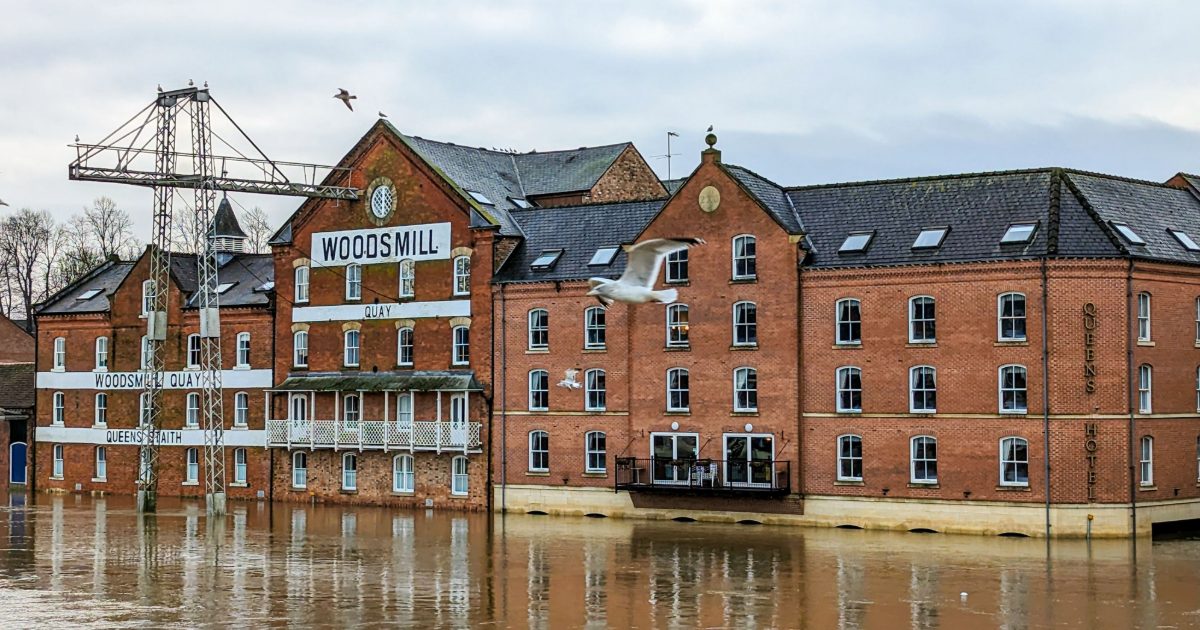
Flooding at Woodsmill Quay, York. Photo: Mike Norris, Pexels (Pexels licence). Illustrative only.
Published 26 November 2026 · A RISE guide · 6–7 minute read
Think of it as an MOT certificate for a home's flood protection. Instead of a single risk score from a map, it describes the actual building: where water could get in, which flood types matter, which measures are fitted, and whether they were done properly.
The idea matters because the people who care about your flood protection, such as your insurer, a buyer, their surveyor or your lender, usually can't see it. A flood door looks like a door. A non-return valve sits out of sight in a drain. Without paperwork, the money you spent can be invisible when it counts.
The Hochwasserpass is run by a not-for-profit body, the HochwasserKompetenzCentrum (HKC). Germany's federal environment agency describes it as more than a certificate: it is "a multi-stage concept". It works in three steps:
HKC says the pass helps with selling, letting and insuring a building. The German insurers' association, the GDV, gave start-up funding. The federal environment agency reports that the first insurers have begun building the pass into their premiums. It also names the main obstacle: the cost and effort of the expert assessment. A cheaper first consultation is planned.
Yes, as research. From 2017 to 2020 a European project called FLOODLABEL, led by Utrecht University with HKC as a partner, built a postcode-based tool that gave homes an A to E flood label across rain, river, groundwater and sewer flooding. It ran case studies in the Netherlands, Germany, Belgium, Austria and the UK.
Its findings will sound familiar to anyone who has been flooded. Homeowners often don't act because they don't know their own risk. The information they're given is written for experts. And many see flood protection as the government's job. The project also concluded that a trained expert still needs to talk a homeowner through a detailed plan, and that linking labels to insurance premiums was "still in its infancy".
Not yet. The closest thing is the Flood Performance Certificate (FPC). On 13 October 2026 Defra and Flood Re announced that work on FPC pilots would start this year in areas at risk of flooding, with more pilots through 2027 and beyond. The government says the aim is for FPCs to become "a trusted source of information", much as Energy Performance Certificates are for energy.
The pilot design includes a Flood Performance Rating that splits risk into exposure, the building's characteristics and its resistance. The government says the certificate should also reflect the steps owners have taken to protect their homes. Flood Re's research partners have set out a standard dataset that combines property details, flood hazard and existing protection measures. Flood Re's stated aim is to link FPCs to discounted premiums by 2028.
A lot is still open. The government says the design is "still being developed". Nobody has said yet who will carry out the assessments, what they will cost, or which areas the pilots will cover. We cover the background in our guide to Flood Performance Certificates and Flood Re's reforms.
You don't need to wait for a certificate. Whatever form the FPC takes, the assessor will want evidence of what is fitted, and so will an insurer at renewal and a buyer's solicitor. Start a simple file now, on paper or in a folder on your phone. We call it a Resilience Record.
| Record | What to keep | Why it helps |
|---|---|---|
| Each measure fitted | What it is (flood door, barrier, airbrick cover, non-return valve, pump), where it is, product name | Shows exactly what protects the house |
| Test or certification | Any standard or certification named on the product paperwork | Shows it was made to a tested design |
| Who fitted it, and when | Installer's name and contact, date, invoice | Proves professional installation and cost |
| Photos | Before, during and after, plus the product label | Hidden work, like valves, stays visible |
| Guarantees and servicing | Warranty, maintenance instructions, dates seals were checked or pumps tested | Shows it still works, not just that it was fitted |
| Surveys and reports | Any flood resilience survey, its recommendations, and which you followed | The closest thing to a passport you can hold today |
| Grant or insurer paperwork | Build Back Better or grant letters, and post-flood drying certificates | Shows who paid for what and that repairs were signed off |
If you used a grant or Build Back Better money, keep those letters with the rest. See Build Back Better, explained and who qualifies for property flood resilience grants.
Not automatically, and not yet. Today an insurer may or may not ask about protection measures, and Flood Re's link to discounted premiums is aimed at 2028. What a record does now is let you answer questions accurately at renewal, show what changed since a past claim, and back up what you say when you shop around.
It also helps when you sell. The property information form asks about flooding and about protection measures, and buyers' solicitors will ask for the evidence. Our guide to answering the TA6 flood question honestly explains how a well-documented "yes" can help a sale.
If your home has flooded, or you've had protection fitted and don't know what paperwork matters, book a case assessment. We'll help you work out what to gather, what's missing, and what to ask your installer for while they still have the details.
Live data from the Environment Agency, refreshed every 15 minutes.
No obligation. No jargon. By the end of the call you will have a clear view of your options — whether you engage RISE or not.
Call any time No callback RISE directly
Help us focus future content
RISE is researching gaps in publicly available flood recovery information. If you have 90 seconds, your responses help us understand what homeowners actually struggle to find clear answers on — and shape what we write next.
Take the 90-second survey →