
Buy them yourself, and buy them before the rain. Most councils in Oxfordshire and Bedfordshire say plainly that they do not hand sandbags out to householders, and the Environment Agency warns not to assume anyone will. Here is where to get them, how to lay them so they actually help, what works better, and how to get rid of them afterwards.
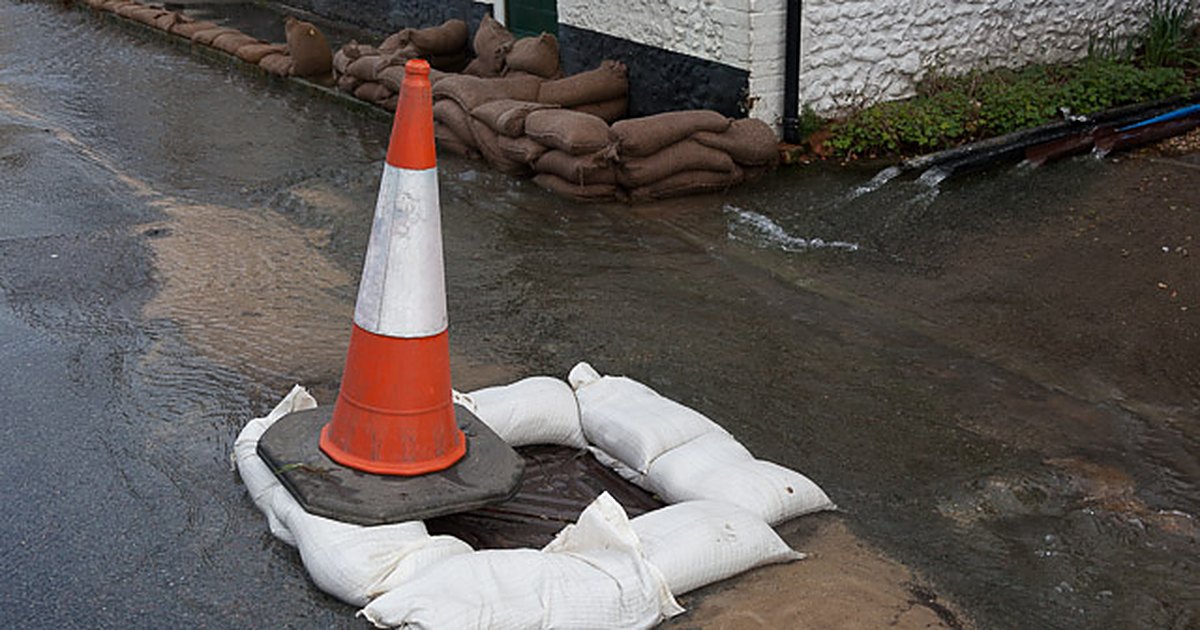
Photo: Peter Facey / Geograph, CC BY-SA 2.0. Hambledon, Hampshire, February 2014 (illustrative).
Published 20 October 2026 · A RISE guide · 5–6 minute read
The short answer to "where do I get sandbags?" is: from a builders' merchant or DIY store, as empty bags plus a load of sand, well before a flood is forecast. When a warning goes out, everyone else has the same idea and shelves empty fast. The Environment Agency's own sandbag guidance opens its section on getting them with a blunt line: "Don't assume that the authorities will provide you with sandbags in a flood emergency!"
Sandbags are also not the best protection you can buy. They help for a short time, they leak, and they take longer to fill than most people expect. This guide covers both: how to get and use sandbags properly, and what to buy instead if you have the choice.
Usually not, and in our four counties the councils that publish a policy say so in writing.
Some town and parish councils and community flood groups do keep their own stores. In Weedon Bec, two tonnes of sandbags were filled and placed for the village's Flood Liaison Action Group earlier this month to cut low-level flooding at a known problem spot. If your village has a flood group, ask what it holds and how it is shared out. If it does not have one, that is a good reason to start one.
Builders' merchants and DIY stores sell empty sandbags and bulk sand; Oxford City Council names Buildbase, Wickes and B&Q as examples. The Environment Agency warns that if a flood is expected locally, "demand may exceed supply as people rush to buy them", so buy before the season, not on the day of the warning.
Store empty bags, sand and a roll of heavy-duty plastic sheeting somewhere dry and under cover. Sacking rots if it is left damp, so filled bags left out by the door for months will not last.
If you have nothing to hand and water is coming, the official advice suggests improvising: the Environment Agency mentions pillowcases or refuse sacks filled with garden soil, and Bedfordshire Fire and Rescue suggests compost bags, carrier bags filled with driveway gravel, or plastic sheeting weighed down with bricks.
A little, for a while. The Environment Agency says they "can keep water out for short periods", that plastic sheeting improves them, and that they filter out some mud. It also lists the drawbacks:
They also only cover doorways. Water gets in through airbricks, gaps where cables and pipes enter, and back up through drains and toilets, which is why the Agency "strongly encourage[s]" purpose-made products instead.
If sandbags are what you have, the Environment Agency's guidance is:
You may see other advice, such as filling bags two-thirds full. We have followed the Environment Agency's guidance here.
Purpose-made property flood resilience products do the same job better and can be kept ready: flood barriers or boards for doors, covers or self-closing airbricks, and non-return valves on drains so sewage cannot back up into the house. West Northamptonshire Council also suggests modern sandbag alternatives you can keep at home, "so they are immediately there when you need them". The National Flood Forum's Blue Pages directory lists suppliers.
These cost more than sand, but you may not have to pay for all of it. Our guides to property flood resilience grants and to Build Back Better after an insurance claim explain who can get help.
Treat any sandbag that has sat in floodwater as contaminated: floodwater can be polluted, including with sewage. Wear gloves, keep children and pets away, and ask your council's environmental health team how to get rid of them, which is what the Environment Agency advises. Oxford City Council publishes its own disposal guidance. Bags that stayed dry can be emptied, dried and kept for next time.
If water has already come in, sandbags will not help. Start with our guide to what to do after a flood, and keep the free flood recovery guide to hand.
Sources: Environment Agency, Sandbags: how to use them to prepare for a flood (GOV.UK; leaflet Sandbags and how to use them properly for flood protection). Cherwell District Council, Flooding and land drainage. Oxford City Council, Preparing for floods and protecting your property. Bedfordshire Fire and Rescue Service, Flooding. West Northamptonshire Council, Flood advice for homeowners. Northamptonshire Police, Fire and Crime Commissioner, flood defences in Weedon Bec (13 October 2026). National Flood Forum, Blue Pages. All read 15 October 2026.
Live data from the Environment Agency, refreshed every 15 minutes.
No obligation. No jargon. By the end of the call you will have a clear view of your options — whether you engage RISE or not.
Call any time No callback RISE directly
Help us focus future content
RISE is researching gaps in publicly available flood recovery information. If you have 90 seconds, your responses help us understand what homeowners actually struggle to find clear answers on — and shape what we write next.
Take the 90-second survey →