
The government's own figures say 99% of proposed new homes meet Environment Agency flood risk standards. A cross-party Parliamentary committee says a law requiring proper drainage in new developments has sat unimplemented for over a decade. Both statements are accurate. That gap is worth understanding.
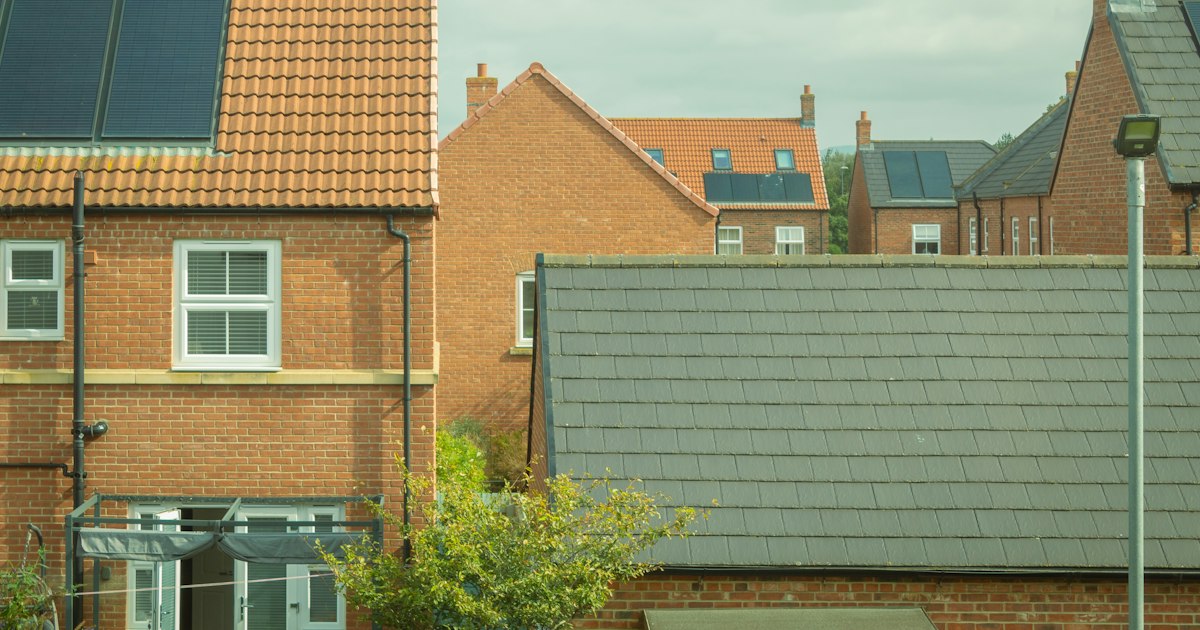
Photo: Frank Chan / Unsplash (illustrative)
Published 26 September 2026 · A RISE update · 7–9 minute read
Two things can be true about new housebuilding and flood risk in England at the same time, and untangling them matters if you own — or are thinking of buying — a home built in the last few years.
The first: the government's own compliance data, published in response to insurer research this year, shows that 96% of all planning decisions in 2024/25 complied with Environment Agency flood risk guidance, and 99% of proposed new homes in those applications met the Agency's flood risk standards. Responding directly to Aviva research claiming one in nine newly built homes faces flood risk, the government argued the insurer's figures were misleading because they don't account for flood defences already in place — pointing to the Thames Barrier's protection of London and Westminster as an example.
The second: an October 2025 report from Parliament's Environmental Audit Committee found that Schedule 3 of the Flood and Water Management Act 2010 — the section of the law that would make Sustainable Drainage Systems (SuDS) mandatory in new developments — still has not been brought into force in England, more than sixteen years after the Act itself received Royal Assent. The practical result, in the committee's own words, is that SuDS remains optional in new developments.
"Flood risk guidance" and "SuDS" are not the same test. Current planning guidance mostly asks whether a development itself will flood, and whether it displaces flood risk onto a river or floodplain elsewhere. It was strengthened again in September 2025 to address surface water flooding more directly, allowing measures such as new drainage systems as part of demonstrating a scheme is safe. What it does not do — because Schedule 3 has never been switched on — is mandate that every new development install the kind of comprehensive sustainable drainage infrastructure (permeable paving, attenuation ponds, swales, soakaways) that reduces surface water runoff at source rather than simply managing where it goes.
The Environmental Audit Committee's report goes further than this one gap. It found that surface water flooding — described as "one of the least understood and least coordinated aspects of flood resilience nationally" — has been historically underestimated and under-resourced; that many flood defence assets lack clear, centrally tracked ownership, maintenance responsibility, or condition assessment; and that there is no single national mechanism for strategic oversight and accountability in flood risk management. It described the system as "fragmented and reactive." The committee's headline funding recommendation was that flood investment should reach at least £1.5 billion a year by 2030 to keep pace with climate-driven risk.
| What's confirmed | Source |
|---|---|
| 96% of 2024/25 planning decisions complied with EA flood risk guidance; 99% of proposed new homes met flood risk standards | Government response to housebuilding/flooding claims, Feb 2026 |
| Government committed £10.5 billion over ten years for flood defence projects, framed as benefiting nearly 900,000 properties by 2036 | Government response to housebuilding/flooding claims, Feb 2026 |
| Schedule 3 of the Flood and Water Management Act 2010 (mandatory SuDS) remains unimplemented in England | Environmental Audit Committee, Flood resilience in England, October 2025 |
| Committee recommendation: flood investment should reach at least £1.5bn/year by 2030 | Environmental Audit Committee, Flood resilience in England, October 2025 |
Passing current flood risk guidance is a real and meaningful bar — it is not nothing. But it is a narrower test than "this development will not increase surface water flood risk to itself or its neighbours over its lifetime," which is the standard Schedule 3 was written to help guarantee. If your home was built in the last decade and back is prone to surface water pooling, standing water after moderate rain, or a slow-draining garden, that is worth investigating on its own terms rather than assuming compliance with planning guidance means the drainage was built to the higher, still-voluntary standard.
None of this is a reason for alarm about any specific new-build estate. It is a reason to ask specific questions — of a developer, a surveyor, or your local planning authority — about what drainage standard was actually applied, rather than assuming the strongest possible standard was used by default.
If your property has already flooded and you want to understand your Lead Local Flood Authority's specific legal obligations under Section 19 of the same 2010 Act, the RISE Section 19 Case Assessment is £250, delivered to your inbox.
Sources: Environmental Audit Committee, "Flood resilience in England" and government response (publications.parliament.uk, committees.parliament.uk, October and December 2025); MHCLG, "Response to claims on housebuilding and flooding" (mhclgmedia.blog.gov.uk, 18 February 2026).
Live data from the Environment Agency, refreshed every 15 minutes.
No obligation. No jargon. By the end of the call you will have a clear view of your options — whether you engage RISE or not.
Call any time No callback RISE directly
Help us focus future content
RISE is researching gaps in publicly available flood recovery information. If you have 90 seconds, your responses help us understand what homeowners actually struggle to find clear answers on — and shape what we write next.
Take the 90-second survey →